
iStock-492971054
Five years ago, I reached out to Transport Canada to see if drivers were complaining about the brightness of headlights, which seemed increasingly blinding at night.
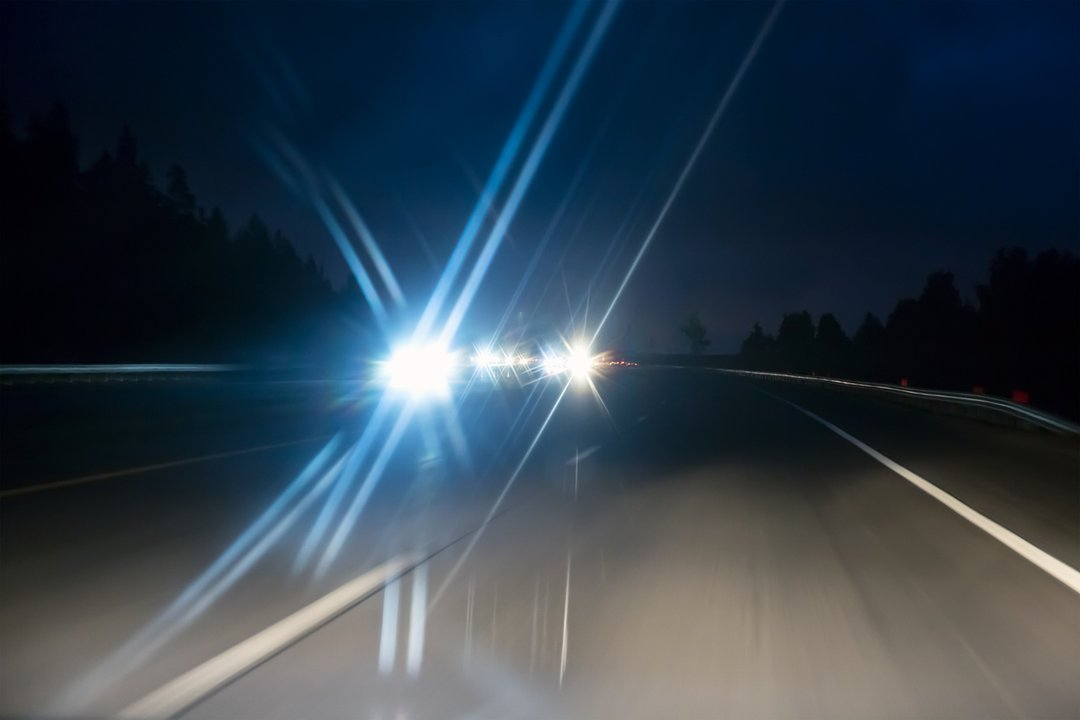
Driving outside Toronto on dark rural roads felt especially scary. I’d find myself white-knuckling it, looking hard right and bracing for impact when an oncoming truck’s snow-white lights flooded its lane — and mine.
Was anyone else feeling this way, too? I wondered. And were these extra-bright headlights even legal?
Expert tips to beat the glare
Keep it clean
Grime on your windshield and haze on headlight lenses diffuses light and amplifies glare. Wipe your windshield regularly, inside and out.
Night-driving glasses? Nope
Automotive lighting expert Daniel Stern urges drivers to steer clear of yellow or amber-tinted glasses that claim to reduce glare.
These glasses reduce the total amount of light. So, while they may take the sting out of bright headlights, they’ll also remove the dim light reflecting off a pedestrian’s dark jacket.
Resist the headlight upgrade
Stern urges drivers to avoid upgrading to LEDs from halogen lights unless the vehicle’s manufacturer has created its own version for your car.
Inserting an LED into a halogen housing can create a “shotgun of light,” scattering beams into the eyes of oncoming drivers.
Also, halogens generate heat that melts snow and ice off lenses. LEDs run cold, allowing buildup that creates a “glare monster.”
The government’s answer arrived by email in December 2021. It read like a shrug.
Transport Canada told me it had documented only 35 complaints a year on the subject going back to 2016 and noted “some of these complaints pertain to enforcement matters for aftermarket headlights” — a provincial/territorial responsibility.
The government said it amended regulations in 2018 to reduce headlight glare on new vehicles, limiting mounting height on larger vehicles and requiring automatic headlamp levelling, information I just recently learned is not entirely true.
The change applied only to headlight technology that follows United Nations standards, says Daniel Stern, a Vancouver-based automotive lighting expert and chief editor of Driving Vision News, which are more stringent on glare than U.S.-Canadian standards. It also represents just a tiny share of new vehicles on the road today.
You can imagine, then, my delight when I saw that Transport Canada launched a national survey last month — using the words “headlight glare” and “problem” in the same sentence.
Since March 6, more than 100,000 Canadians have completed the survey, a government spokesperson confirmed. The poll closes April 20.
“I thought I was all by myself,” Lynda Orr, 76, tells me by phone from her home in New Westminster, B.C. “I feel validated.” She stopped driving at night a few years ago. The beams of oncoming traffic made her feel nauseous.
“It was actually frightening,” she says. “You want to swerve because you just can’t see.”
Orr assumed she had cataracts until her ophthalmologist confirmed her eyes weren’t the problem.
Canada isn’t the only country grappling with the issue, and the United Nations even struck the Task Force of Glare Prevention in 2024.
In the U.K., politicians and consumer groups are petitioning for more stringent regulations on what they call “dazzle” — a term borrowed from the ‘dazzle camouflage’ applied to First World War ships to stun and confuse the enemy.
A subreddit group (I wish I’d launched) called r/F*YourHeadlights has swelled to nearly 60,000 members, all sharing photos and anecdotes of headlight horrors.
In Canada, there is no compelling evidence that modern LED headlights — which often feature a “blue peak” that can leave oncoming drivers feeling momentarily blinded — actually cause accidents.
Mostly, though, it’s because investigators haven’t been asked or trained to look for the connection, says Stern. While consumers have grumbled for decades about the changing colours and intensity of headlights, he says the noise this time is different.
“It’s not dying down. Political will is developing on the matter in a way it hasn’t before,” which Stern links to the “volume, pitch and particularly the persistence of complaints.”
While consumer revolt is powerful, robust data can provide the tipping point that forces industry change.
RAC, a British automotive roadside service and advocacy company similar to Canada’s CAA, has been conducting its own research on headlight glare/dazzle for years, with sobering statistics on its physical, social and emotional impact.
Canada is finally following suit with its own research, and its findings are expected to be presented at a global vehicle safety conference in Toronto next month and shared with the UN task force.
This summer, scientist Bruce Haycock, at University Health Network’s KITE Research Institute in Toronto, will lead a separate comprehensive study on how headlight glare impacts driving behaviour.
Haycock’s simulation lab will use an eye tracking system that shows where a motorist’s eyes go when faced with intense headlights.
“Do they slow down in the presence of the glare? Do they drift out of lane?” Those questions will be answered, too, Haycock says.
He’ll also measure glare’s effects in various weather systems.
In June, the Federation of Canadian Municipalities will vote at its annual convention in Edmonton on whether to endorse a members’ motion to use its collective power to petition Ottawa for legislative change on headlight glare.
The motion came in January from Vancouver City Councillor Sean Orr (Lynda’s son) and was passed unanimously even though he’s new to politics, having won his seat only nine months earlier in a byelection. His speech to council included a passing reference to his mom. Victoria’s municipal council later approved a similar motion.
Orr, the son/politician who drives a bicycle more than a car, calls himself an “accidental advocate” on the issue.
“It wasn’t my cross to bear,” he told me over the phone recently, but he had a hunch it would resonate.
“Once you start noticing it, you can’t unsee it.”
Author:
-

iStock-492971054
Comments are closed.
 The information provided here is for general information purposes only and is based on the opinion of the owners and writers only, subject to change without notice. It is not intended to provide specific personalized advice including, without limitation, investment, financial, legal, accounting or tax advice. Every effort has been made to compile this material from reliable sources; however, no warranty can be made as to its accuracy or completeness. Before acting on any of the above, please contact your advisor for individual financial advice based on your personal circumstances.