

Rarely have economists spoken in such unison. Even before Donald Trump’s “Liberation Day” tariffs on April 2nd, the median estimate among the 48 who were surveyed by the University of Chicago’s business school was that Mr Trump’s levies would raise inflation in 2025 by 0.8 percentage points.

iStock-2212925387
Meanwhile, the president’s position is that, in his press secretary’s words, “tariffs are a tax hike on foreign countries [which]…have been ripping us off”. The implication is that foreigners will “eat the tariffs” and leave America’s consumer prices unaffected.
When the first post-Liberation Day data for personal-consumption expenditures (pce), the Federal Reserve’s preferred price index, came out on May 30th, evidence of tariffs’ impact was strikingly absent: seasonally adjusted goods prices rose by just 0.1% in April. Many companies will have hoarded imports and drawn down inventories in order to avoid raising prices. But the administration should not be cheering just yet. With tariffs higher than during much of the Depression, consumers are bound to see some effect in time. The question is how much, and how soon? To answer it, The Economist has produced an estimate of the impact of tariffs on prices, which we will update monthly.
The most straightforward way to measure this effect would have been to calculate the share of American consumer spending represented by imports from each country, before multiplying it by tariff rates. Unfortunately, doing so would be too simplistic. Although consumers bear much of the cost of tariffs, American and foreign firms pay a share as well, and imports represent only part of a retail price: much of the cost of a shirt, for instance, goes on rent, wages, transport fees and profits. Moreover, many imports are intermediate goods, such as the crude oil that gets refined into petrol once in America.
Pricing protectionism
Fortunately, a recent paper by Omar Barbiero and Hillary Stein of the Boston Fed tackles these issues, modelling all the channels through which imports feed into shopping baskets. Since America is a fairly self-sufficient, services-driven economy, the duo find that the potential impact of tariffs on consumer prices is small. In 2023 imports that were directly consumed made up 6% of the core PCE index, which excludes food and energy. Those of inputs like steel, after counting all the products that use them, constituted another 4%.
Their study did not address one crucial question: how behaviour will change. In the long run, exporters will probably shift production to countries that face lower levies, even if doing so makes manufacturing less efficient. This should yield costs somewhere between the previous level and the rate implied by new tariffs. Similarly, consumers may switch to inferior local goods, or buy different products altogether. Such adjustments are difficult to predict. However, if tariffs do raise prices, then the gap between goods facing heavy levies and those with lower ones will grow during Mr Trump’s term. Our estimate of the “tariff tax” rests on this comparison.
The first step in calculating the tax is determining the tariff rate for each possible pairing of a product and an exporting country on each day. There is no website listing all current tariffs. Officials rely on a bulletin run by Customs and Border Protection, which updates after every executive order. With the help of Chatgpt, we have extracted data from these messages and reconstructed the shifting rules.
Next, using these rates and historical data, we calculated the average tariff on each product on each day, assuming trade patterns remain unchanged. In late April, for goods often imported from China, such as prams, this was 141%. By contrast, for those like cod, which comes from lightly tariffed countries, it was 11%.
Using the method outlined in the Fed paper, we calculated the share of total consumer spending accounted for in 2024 by imports of each product in each of 212 pce sub-indices. For most services, this was tiny: for expenditure on lawyers it was just 3%, reflecting attorneys’ use of, say, computers and phones. It was far higher in categories where imports account for much of the final price paid by consumers, reaching 47% for televisions.
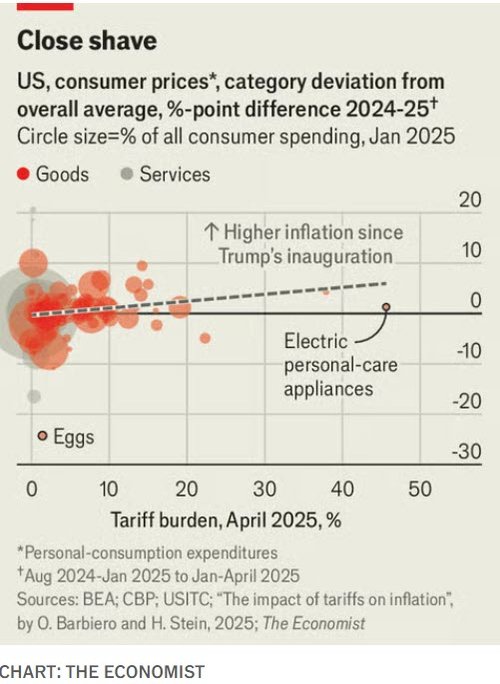
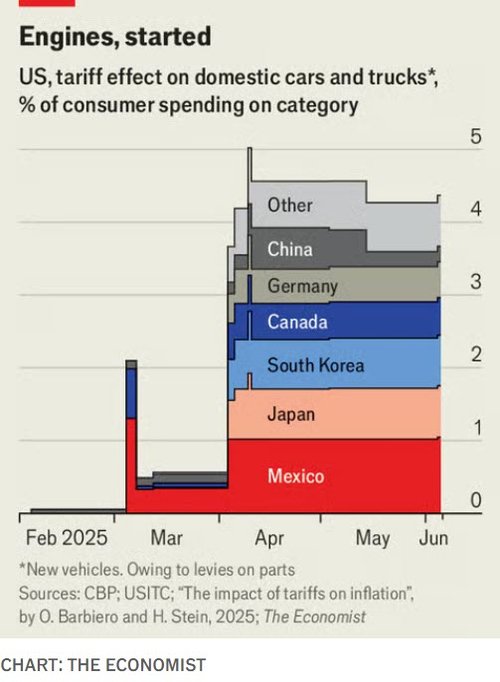
Last, we multiplied these proportions by the tariffs for each product and country, yielding the tax burden in each category. Most affected is “electric personal-care appliances”. For every dollar spent on hairdryers, razors and so on in late April, importers faced a bill of 59 cents, of which 56 came from China’s triple-digit rate. The next-highest categories—small appliances (total burden of 49%), cook- and tableware (28%); and military uniforms (25%)—were also dominated by China. The 18% on personal computers in early May came from China (7.6 percentage points), Mexico (4.8), Taiwan (2.6), Vietnam (1.6) and Thailand (0.7). Of the 9.2% on watches, in effect only on April 9th, Switzerland accounted for 5.7 percentage points. Cars produced at home faced a still lower burden.
In practice, prices for hairdryers did not rise by 59%. But using these notional rates, we can estimate the tariffs’ effect on inflation. For each category, we first measured how much its inflation rate differed from the economy-wide average during Joe Biden’s final six months in office. We compared this with the corresponding figure for the period from January to April. Then we tested how changes in relative inflation rates following Mr Trump’s inauguration lined up with his tariffs.
So far, their impact has been modest. In April each percentage point of increased input cost from tariffs for a given category was associated with 0.14 points of “excess inflation” for that grouping. Because the consumption basket consists mostly of tariff-free services, these costs have risen by almost 1% economy-wide. Holding all else equal, this implies prices are just 0.13% higher than if Mr Trump had never imposed new tariffs.
No one knows where tariffs are heading. However, even if they remain at or below their current levels, firms may raise prices because of the tremendous uncertainty. If they do, prices for goods should rise relative to those for services, which would increase our estimate of the tariffs’ impact. To know whether to blame Mr Trump if your Amazon basket seems strangely expensive, watch this space. ■
Comments are closed.