
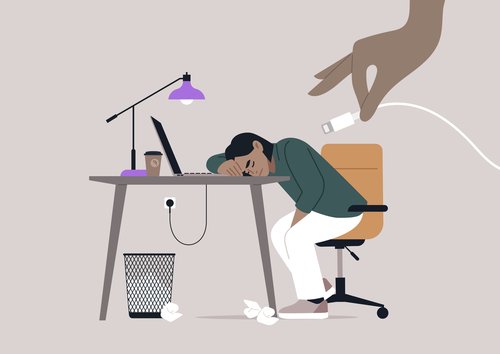
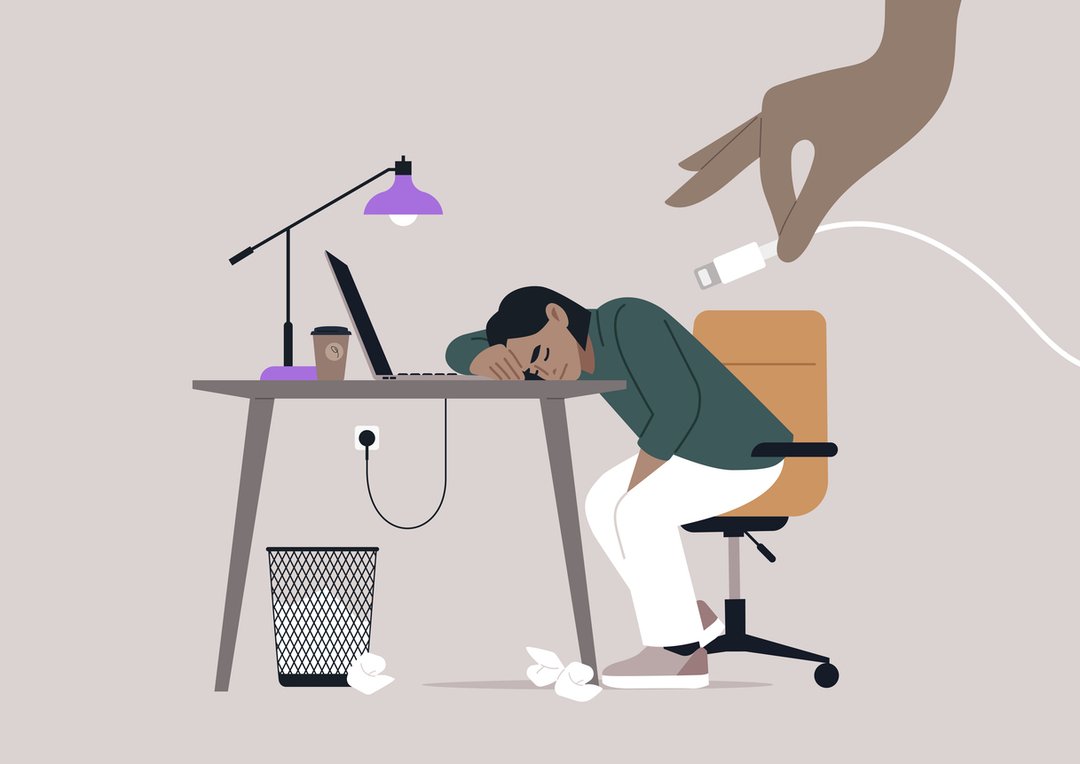
Summary. Digital exhaustion is a modern workplace challenge that arises not from poor management, but from the way digital tools disrupt our cognitive and emotional balance. Fragmented attention, constant context switching, and the need to infer meaning from limited digital cues all contribute to this phenomenon. These factors force our brains to work harder, leaving lingering effects that impair performance and drain energy.
iStock image
It’s 6:30 PM, and you’ve been in back-to-back meetings since 8:00 AM. Your inbox shows 137 unread messages, your Slack notifications have hit triple digits, and you have three dashboards open with data that needs review before tomorrow. You feel that familiar hollowness setting in—not physical fatigue or job burnout but a distinctly modern form of depletion. You’re experiencing what research now identifies as “digital exhaustion.”
Unlike traditional burnout, digital exhaustion doesn’t require poor management or toxic culture. It can flourish even in well-functioning organizations with supportive leadership. That’s because it stems from the very tools we’ve adopted to make work easier and more efficient. Drawing on two decades of research with more than 12,000 knowledge workers, I’ve identified patterns behind this growing crisis, along with eight evidence-based rules that leaders can implement immediately.
What Drives Digital Exhaustion?
Digital exhaustion isn’t caused by our devices themselves. Rather, it stems from how these devices connect us to information and people in ways that fundamentally challenge our cognitive architecture and emotional reserves. Three interconnected forces work together to deplete our energy through our digital interactions.
First, our digital technologies fragment our attention in unprecedented ways. When we constantly shift our focus between email, spreadsheets, chat messages, and video calls, our brain must repeatedly redirect blood flow to different neural regions. A modern knowledge worker makes nearly 1,200 such transitions daily, with each transition requiring several seconds of neural retooling. More importantly, these transitions leave what researchers call “attention residue,” lingering activation that impairs performance on subsequent tasks for up to 23 minutes.
Second, the limited information context of digital communications forces us to make constant inferences. When we receive a terse email or an unexpected meeting invitation, we don’t just process the information, we actively construct meaning by filling gaps with assumptions about intentions, emotions, and circumstances. This inference-making process engages energy-intensive regions of our prefrontal cortex that evolved for occasional social navigation, not constant deployment throughout our workday.
Third, our digital interactions trigger potent emotional responses without providing the regulatory cues that modulate face-to-face encounters. Studies show that digital communications activate our amygdala similarly to in-person interactions, but without the mitigating nonverbal signals that help calibrate emotional intensity. This creates extended states of emotional arousal that persistently drain our energy reserves.
The good news is that these drivers do not inevitably lead to digital exhaustion. If we learn to re-orient to our devices we can avoid that depleting feeling that so often suffuses our work and personal lives.
How-to Defeat Digital Exhaustion
- Stop using half your tools.
Digital tool proliferation represents one of the most underrecognized drivers of executive exhaustion. The average knowledge worker now uses 34 different digital tools, more than four times the number from the early 2000s. This proliferation creates not just routine context switching but what cognitive scientists call “modality shifts,” changes between fundamentally different forms of interaction requiring comprehensive neural retooling.
Consider Alicia, chief marketing officer at a midsize software company. When we tracked her digital usage patterns, we found she was actively using 41 distinct digital tools. Approximately 30% of these tools duplicated functionality available elsewhere.
Addressing this problem begins with a comprehensive inventory of your digital tools. When Alicia implemented this approach, she eliminated 18 tools entirely and limited another 12 to scheduled weekly usage. She created friction for accessing nonessential tools by removing desktop shortcuts and disabling push notifications. These changes resulted in a nearly 70% reduction in context switching and Alicia reclaimed nearly two hours daily and experienced a dramatic decrease in her levels of exhaustion.
- Make a match. Digital channels vary dramatically in their capacity to convey nuance, context, and emotion. Yet most executives apply a one-size-fits-all approach to digital communication, creating profound misalignments that drive exhaustion. There are three critical dimensions for effective channel selection: equivocality, coordination need, and symbolic weight.
Jeffrey, general counsel at a multinational corporation, found himself spending more than two hours daily clarifying email misunderstandings. The solution wasn’t to abandon email entirely, but to create a systematic matching framework. If an issue required more than two email exchanges, it automatically triggered a video call. For routine approvals and data sharing, he maintained efficient text-based channels. Most importantly, he explicitly communicated this framework to colleagues, making channel shifts expected rather than exceptional.
This approach transformed his communication patterns. Email volume decreased by nearly 60% while resolution time on complex issues dropped in half. The key is that different channels excel at different tasks—video calls provide rich nonverbal cues essential for nuanced discussion but create significant coordination overhead, while text-based communication enables asynchronous efficiency but struggles with ambiguity.
- Batch and stream. Most managers adopt one of two strategies for handling incoming digital communications: batching and streaming. Batching means setting aside defined times to process messages in bulk. This method takes advantage of efficiency by letting the brain stay in a consistent processing mode, which can cut per-message handling time significantly. The tradeoff is that messages pile up, and people often feel anxious knowing there are unanswered items waiting. Streaming means responding to messages as they arrive. It resolves issues quickly and reduces the need to remember to follow up later, but it comes at the cost of constant interruptions and fragmented attention.
Elena, CFO at a healthcare organization, discovered that neither extreme worked for her. By studying her own energy patterns, she built a hybrid system: scheduled batch processing for most correspondence, paired with selective streaming for truly urgent matters. A carefully curated VIP list earned immediate attention, while everything else waited for three daily processing windows.
This tailored approach reduced her daily interruptions by more than 40% while maintaining responsiveness for matters that truly couldn’t wait. The optimal approach recognizes that different information types require different processing rhythms.
- Wait one hour, one day, one week. Digital tools have fundamentally altered our expectations around communication timing. Research reveals a pervasive “email urgency bias” in which recipients believe senders expect responses much faster than senders actually report. This misperception creates a vicious cycle where rapid responses elevate expectations, leading to heightened pressure and increased exhaustion.
Michael, managing director at a consulting firm, implemented a tiered approach for responding to messages: one hour for straightforward inquiries, one day for complex questions requiring research, and one week for strategic matters demanding thoughtful consideration. Not only did interruptions decrease dramatically, but client satisfaction scores actually increased as responses became more thorough and comprehensive. Perhaps most surprisingly, approximately two-thirds of communications initially deemed “urgent” resolved without his intervention during the waiting period.
Implementation begins with explicit communication about response patterns. Michael proactively set expectations through simple acknowledgments confirming receipt while establishing appropriate timeframes. Waiting isn’t about responding less, it’s about responding better through deliberate timing.
- Don’t assume. Digital communications strip away crucial contextual cues that humans evolved to rely on for interpersonal understanding. Without these signals, our brains automatically fill gaps with assumptions that trigger the same neural pathways as verified information.
Rajiv, a VP at a financial services company, found himself spending hours ruminating about messages from his CEO, creating elaborate negative interpretations based on minimal data. By implementing “assumption audits,” Rajiv transformed this pattern. For any triggering communication, he documented observable facts, his assumptions beyond those facts, and at least two alternative interpretations.
More importantly, Rajiv developed verification strategies for high-stakes communications. Rather than treating assumptions as facts, he implemented explicit clarification: “I’m interpreting your message as suggesting X. Is that what you intended?” By developing this metacognitive awareness, Rajiv reported that he felt “much lighter and less prone to make unfair assumptions about coworkers.” He also reported that this new approach led to much faster decisions.
- Act with intention. Elena, chief strategy officer at a healthcare company, found herself spending three to four hours daily on devices without meaningful progress on strategic priorities. Analysis revealed most digital sessions began with legitimate purpose but quickly devolved into undirected browsing. The solution wasn’t using technology less, but using it with greater intention.
Before engaging any digital tool, Elena explicitly articulated her specific purpose. For each digital session, she established clear completion criteria signaling successful accomplishment. She implemented environmental triggers for disengagement using physical cues like standing up or changing location that interrupted unconscious patterns.
While her total time on digital devices decreased by only about 15%, she estimated that her productive output increased by almost 50%. By eliminating aimless digital activity, she reclaimed not just time but mental energy previously lost to low-value engagement.
- Learn vicariously. While digital technologies can exhaust us through active engagement, they can also energize us if we use them correctly.
James, head of product at a technology company, dedicated 45 minutes three times weekly to “digital eavesdropping”—reviewing public channels, project documentation, and knowledge repositories without interaction requirements. He discovered connections between seemingly unrelated projects, identified expertise he hadn’t previously recognized, and developed contextual understanding that improved his decision-making.
By curating customized information feeds, James exposed himself passively to the flow of work across the company. This created what cognitive scientists call “vicarious learning,” absorbing patterns and insights without deliberate effort. For example, by regularly scanning updates in an engineering channel, he noticed that two teams were solving similar problems in parallel. He adapted one group’s approach to his own project, saving weeks of trial and error.
- Be here, not elsewhere. Digital technologies create unprecedented capacity for mental teleportation. While this possibility offers flexibility, it prevents achieving flow—the psychologically rewarding state of complete absorption critical for both performance and wellbeing. Being in a state of flow is the antithesis of digital exhaustion.
Maya, chief marketing officer at a retail company, realized she was spending nearly five hours a day in fragmented digital engagement. To reclaim that sense of being here rather than scattered across digital spaces, she redesigned her schedule around longer stretches of uninterrupted focus. She blocked two-hour windows for deep work, silenced notifications, and committed to single-tasking during those sessions. Between these blocks, she turned to complementary activities that refreshed her mind without breaking engagement. These practices helped find flow in the task at hand, sustaining concentration while avoiding the exhaustion that comes from always being elsewhere.
Creating a Sustainable Digital Culture
While managing your own digital exhaustion is critical, as a leader you also significantly influence your team’s digital wellbeing. The cultural norms you establish through both example and explicit guidance create the foundation for sustainable digital engagement throughout your organization.
Lead by example, not policy. Leaders’ digital behaviors create implicit norms that override any written policies. When you send emails at midnight, you telegraph the expectation of round-the-clock availability regardless of what your handbook states.
Carlos, operations director at a manufacturing company, discovered his late-night emails were creating anxiety among his team despite explicit statements that immediate responses weren’t expected. His solution was implementing email scheduling that delivered messages during business hours and openly discussing his own digital struggles with his team.
Create explicit team agreements. Digital overwhelm often stems from mismatched expectations about tools, timing, and availability. Marina’s product team developed a “digital communication charter” that transformed their culture by specifying appropriate channels for different communication types, expected response times, and notification norms. This shared framework reduced daily digital interruptions by over 60% while simultaneously improving coordination.
Design your organization’s communication architecture. Most digital exhaustion stems from structural issues that individual willpower cannot overcome. Dev’s engineering team established “No-Meeting Wednesdays” combined with notification silencing during designated deep work blocks. By explicitly mapping which tasks required collaboration versus focus, and designing workflows that grouped compatible activities, they significantly reduced the cognitive load previously created by misaligned expectations.
Redefine Success Metrics. Performance metrics profoundly shape digital behavior. Sarah, a director of customer success, discovered her team was producing extensive documentation primarily to demonstrate productivity rather than deliver value. By shifting performance metrics from outputs to outcomes, she transformed their digital culture. This redefinition of success reduced unnecessary digital activity by 47% while improving key performance indicators.
+++
Digital exhaustion isn’t inevitable. It stems from unconscious patterns of technology use that we can transform through deliberate practice. The eight rules outlined here provide a framework for leaders to reclaim both their own digital wellbeing and that of their teams.
As we enter an era of accelerating technological change, particularly with the rise of AI and increasingly immersive digital environments, the need for these approaches becomes even more critical. The leaders who thrive will not be those who embrace every new technology without question, nor those who resist change out of fear. Rather, success will belong to those who develop nuanced, intentional relationships with technology that maximize its benefits while minimizing its costs.
———
Paul Leonardi is the Duca Family Professor of Technology Management at the University of California, Santa Barbara, and advises companies about how to use social network data and new technologies to improve performance and employee well-being. He is the coauthor of the book The Digital Mindset: What It Really Takes to Thrive in the Age of Data, Algorithms, and AI.
c.2025 Harvard Business Review. Distributed by The New York Times Licensing Group.
Comments are closed.